Resources

This page brings together free educational content exploring PDA through a neuroaffirmative, nervous system–led lens.
Everything here is offered to support understanding, reflection, and learning…not compliance, behaviour change, or quick fixes.
You are welcome to engage with these resources in whatever order feels accessible
These PDFs are based on my most shared educational content and are designed to be printable, shareable, and accessible. They are suitable for home, school, and professional settings.
Downloadable Resources
Free Guide
This free guide was created to support parents navigating the often overwhelming process of seeking assessments and therapy for neurodivergent children and young people in Ireland.
Families are frequently told to “get an assessment” or “seek support,” but are not given clear guidance on where to go, who is appropriately qualified, or what types of support are actually helpful.
Written by an AuDHD, PDA adult and Senior Occupational Therapist, this guide combines both clinical experience and lived understanding. It draws on years of reviewing assessment reports and working directly with families to highlight what high-quality, neuroaffirmative support looks like—and how to recognise when something may not meet best practice.
Inside, you will find:
A clear breakdown of the Irish system (CDNT, Primary Care, CAMHS)
Guidance on understanding professional roles and qualifications
How to identify red flags and green flags when choosing support
A practical overview of common assessments (e.g. WISC, ADOS, ADI-R, MIGDAS-2)
Insight into more neuroaffirmative, child-led approaches
Questions to ask professionals and a sample email template
This guide is designed to help you feel more informed, more confident, and more supported as you make decisions for your child.
It is completely free and can be shared widely with families, schools, and professionals.
PDA (Persistent Drive for Autonomy)
-
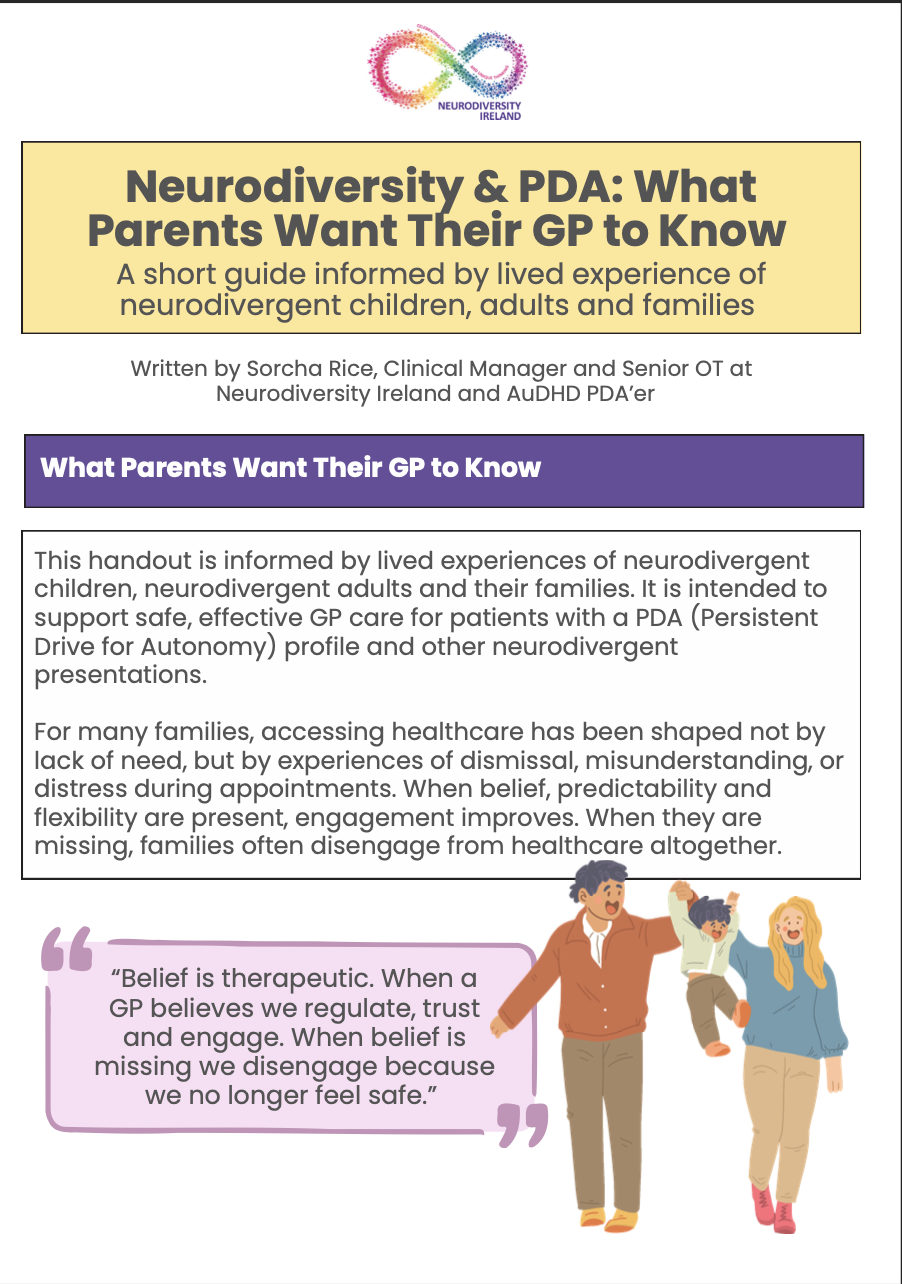
This handout shares what parents of PDAers and other neurodivergent children want their GP to understand in order to provide safe, effective, and accessible healthcare.
Grounded in lived experience and a nervous system–led occupational therapy framework, it explains how medical settings can become highly threatening for PDA nervous systems — and how belief, predictability, flexibility, and regulation support dramatically improve engagement and outcomes.
This is useful if you want to:
help GPs understand PDA beyond behaviour or anxiety
reduce medical trauma and healthcare avoidance
support safer appointments through declarative language and predictability
advocate for belief, listening, and parental expertise
share practical guidance directly with healthcare professionals
Designed to be shared with GPs and healthcare teams to support neuroaffirmative, regulation-first medical care.
-
This resource explains why PDA is not an anxiety presentation, and why understanding PDA through an anxiety lens often leads to support that unintentionally increases distress.
Drawing on nervous system science, occupational therapy frameworks, and lived experience, it clearly distinguishes between anxiety-driven distress and autonomic survival responses to demand and loss of autonomy. It shows how PDA behaviour emerges from body-first threat responses, not anxious thinking — and why common anxiety strategies (such as reassurance, exposure, or cognitive approaches) can escalate PDA distress when misapplied.
This is useful if you want to:
understand the difference between anxiety and PDA at a nervous system level
avoid supports that increase pressure, shame, or burnout
recognise why behaviour can change rapidly across contexts
support PDAers through safety, predictability, autonomy, and regulation
advocate for more accurate, ethical, and effective support
Designed for parents, educators, and professionals who want a clear, evidence-informed explanation of why PDA requires a different framework than anxiety.
-
This evidence-based handout is designed to support parents and healthcare professionals when a PDA’er presents with significant constipation, withholding, or toileting distress in medical settings. It clearly explains why these difficulties are not behavioural, but rooted in nervous system dysregulation, interoception differences, pain history, and autonomy threat responses.
-
Christmas for PDA’ers is a gentle, neuroaffirmative guide designed to help grandparents and extended family understand how the Christmas period can be overwhelming for children with a Persistent Drive for Autonomy (PDA). Drawing on lived experience and family voices, the resource explains why common holiday expectations — such as surprise visitors, traditional meals, busy gatherings, social niceties, and gift-opening rituals — can create significant nervous system stress.
The document breaks down common pressure points and offers practical, compassionate alternatives that prioritise safety, predictability, autonomy, and regulation. It reframes behaviours often misunderstood as rudeness or misbehaviour as signs of overwhelm and communication differences, and provides clear guidance on food, sensory needs, communication, transitions, and family gatherings.
At its core, the resource encourages adults to shift from changing the child to changing the environment, showing how reducing pressure and honouring individual needs can create a calmer, more joyful Christmas for PDA’ers and their families — and a more connected experience for everyone involved.
-
This document shares the lived experiences of 238 parents of neurodivergent children in Ireland, offering clear evidence that school burnout is not about poor attendance, laziness, or parental attitudes, but about nervous system overload and unmet needs.
It reframes school burnout as a survival response, showing how masking, sensory overload, relentless demands, and lack of regulation support lead to exhaustion, shutdown, anxiety, physical illness, and loss of access to daily living skills. The data highlights the gap between how children appear in school and the impact felt at home, alongside systemic barriers to accessing timely support.
This is useful if you want to:
understand school burnout as nervous system communication
hear parent voices that are often missing from policy discussions
challenge attendance-focused narratives that ignore wellbeing
advocate for regulation-first, neuroaffirmative school support
inform practice, training, or policy with lived experience data
Designed for parents, educators, professionals, and policymakers seeking a more ethical and realistic understanding of school attendance and burnout.
Download Here
-
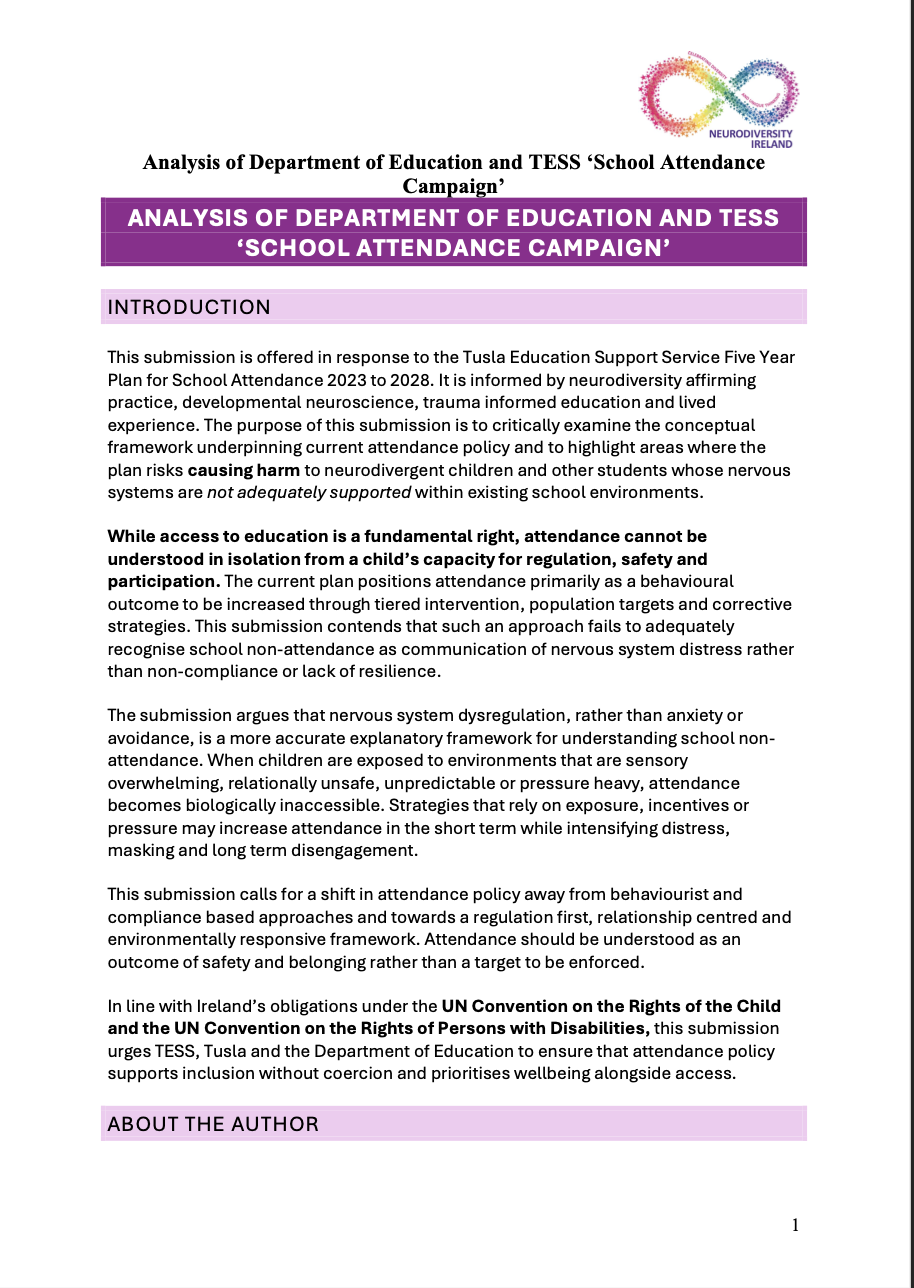
This analysis examines Ireland’s national school attendance campaign through a neurodiversity-affirming, nervous system–led lens, highlighting where attendance policy risks causing harm to neurodivergent children and families.
It reframes school non-attendance as communication of nervous system distress, not lack of motivation, resilience, or parental effort. Drawing on occupational therapy, trauma-informed practice, lived experience, and policy analysis, it shows how attendance targets, reward systems, exposure-based approaches, and shame-driven messaging can increase masking, burnout, and long-term disengagement — even when attendance appears to improve.
This is useful if you want to:
understand school non-attendance as a regulation and safety issue
critically examine attendance policies and campaigns
challenge compliance-based and behaviourist attendance frameworks
advocate for regulation-first, rights-based educational practice
inform policy, leadership, training, or systems-level change
Designed for parents, educators, professionals, advocates, and policymakers seeking a more ethical and evidence-informed approach to school attendance.
-
NCSE Relate is a regulation-first, neuroaffirmative framework developed by the National Council for Special Education to support student engagement, participation, and wellbeing in schools. It reframes behaviour as communication and stress response, rather than something to be managed or corrected, and places relationships, nervous system regulation, and environmental supports at the centre of practice.
The framework emphasises co-regulation, unconditional positive regard, student voice, and universal design for learning, recognising that barriers to participation often sit within the environment rather than the child. NCSE Relate supports schools to move away from compliance-based approaches and towards inclusive, relational, and solution-focused practices that benefit all students, particularly neurodivergent learners.
-
This resource supports autism class teachers to move toward a regulation-first, child-led, neuroaffirmative approach to teaching and learning. Grounded in lived experience, classroom practice, and the NCSE RELATE framework, it reframes behaviour as communication and stress response rather than non-compliance, emphasising that learning is only possible when the nervous system feels safe.
The handout outlines why traditional behaviour-based systems, reward charts, and workstations can increase pressure, masking, and dysregulation, and instead highlights the importance of co-regulation, autonomy, and relational safety. It demonstrates how child-led play, interests, and sensory-aware environments provide meaningful access to the curriculum while supporting regulation and engagement.
Overall, the document encourages teachers to prioritise safety, relationships, and understanding each child’s regulation needs, showing that when stress is reduced and trust is built, communication, curiosity, and learning naturally follow.
School Burnout
-
Download this handout to see a real-life example of how a thoughtfully designed environment can support regulation without singling any child out. Using St. David’s N.S. sensory wall as the model, it highlights how predictability, shared access, and built-in sensory supports naturally reduce pressure and increase safety for neurodivergent learners.
It shows how simple, intentional design choices — switches, tactile panels, deep pressure input and cause-and-effect elements — can support autonomy, engagement, and regulation during everyday school transitions. This resource is ideal for educators and therapists who want practical inspiration for creating inclusive, neuroaffirming environments that work for all children.
-
Using Energy Metres in Class introduces a regulation-first, neuroaffirmative, whole-school approach to supporting engagement, wellbeing, and learning. Rather than focusing on behaviour or compliance, the resource uses the neutral language of energy to help staff and students understand nervous system needs without judgement or shame.
The handout explains how learning is only possible when the nervous system feels safe, and how mismatches between a child’s energy and the demands of an environment can lead to dysregulation. Energy metres provide a shared, accessible way to notice early signs of stress, support regulation before crisis, and reduce reliance on reactive strategies that don’t work once a child is overwhelmed.
Designed as a universal approach, energy metres normalise regulation for everyone, reduce masking, and remove pressure from individual children. When embedded into daily routines and the physical environment, they support autonomy, predictability, and co-regulation — creating classrooms where regulation is built in and learning can happen.
-
This handout supports educators to understand behaviour as nervous system communication, not defiance, and explains why regulation must come before learning.
Using a sensory and PDA-informed occupational therapy lens, it shows how pressure, unpredictability, and loss of autonomy impact capacity in the classroom — and how this affects behaviour, communication, sleep, feeding, toileting, hygiene, and safety.
This is useful if you want to:
move beyond behaviour management in schools
understand the Pyramid of Learning and why regulation comes first
recognise both visible and masked dysregulation
support regulation through co-regulation, autonomy, and predictability
create classroom environments where regulation happens naturally
Designed for school staff and professionals, this resource offers practical, neuroaffirmative guidance grounded in occupational therapy and lived experience.
-
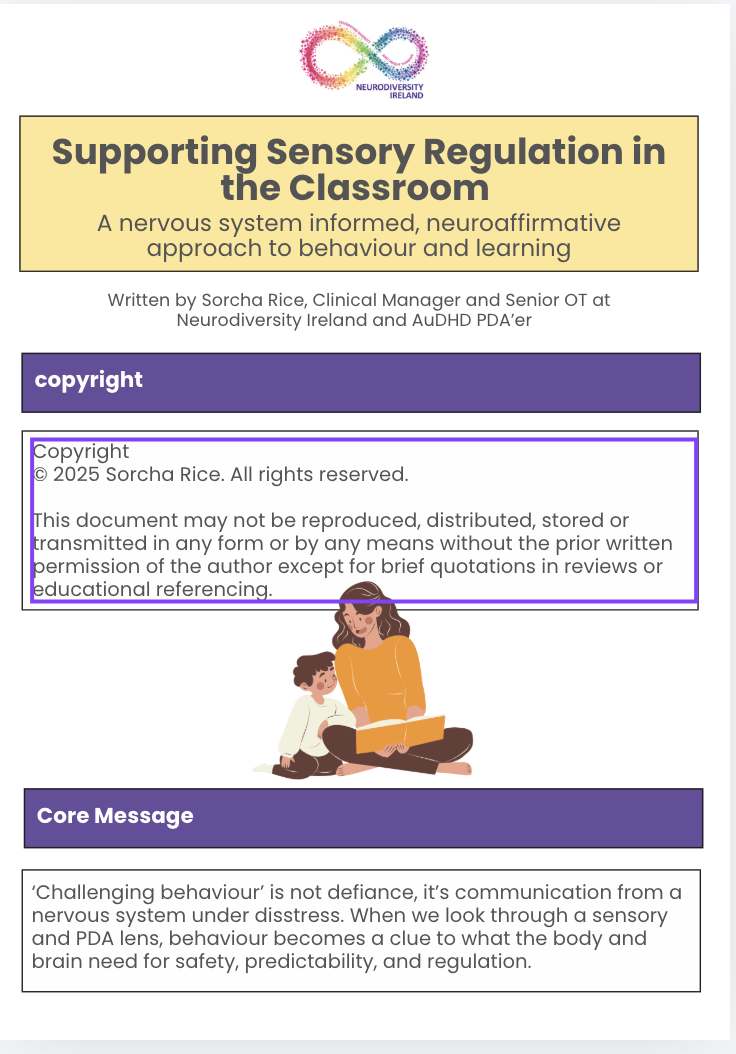
This resource reframes so-called “challenging behaviour” as communication from a nervous system under stress, not defiance or poor motivation.
It explains behaviour through a sensory and PDA-informed occupational therapy lens, showing why regulation and safety must come before reasoning, consequences, or learning. Using the Pyramid of Learning, it clarifies how sensory overload, pressure, and loss of autonomy close capacity — and how this shows up in behaviour, communication, sleep, feeding, toileting, hygiene, and safety.
This is useful if you want to:
move beyond behaviourist interpretations
understand PDA behaviour as a survival response
recognise early signs of dysregulation, including masked distress
support regulation through co-regulation, autonomy, and environment
create safer, more effective school and home supports
Designed for parents, educators, and professionals, this resource offers practical, neuroaffirmative guidance grounded in occupational therapy and lived experience.
-
This handout provides a neuroaffirmative overview of sensory regulation tools that may support neurodivergent children’s regulation, participation, and sense of safety in school and everyday environments. Developed by a neurodivergent Senior Occupational Therapist, it explains how different sensory items offer specific forms of input — such as deep pressure, proprioception, oral input, vestibular input, and cause-and-effect — to support nervous system regulation rather than behaviour management.
The resource emphasises that these tools are suggestions, not prescriptions, and encourages families and schools to trial items based on the child’s individual sensory needs, capacity, and preferences. Clinical reasoning is provided for each item to help adults understand why a tool may be supportive, while maintaining a strong focus on autonomy, dignity, and nervous system safety.
-
Chiropractic marketing increasingly claims that “nervous system misalignment” causes a wide range of physical, emotional, and ‘developmental challenges..including autism and ADHD.’
In this evidence-informed deep dive, I unpack what these claims actually mean, examine the science behind “subluxation” theory and explore why framing neurodivergence as a structural blockage is both unsupported and potentially harmful.
If you’re a parent, educator, or clinician seeking clarity and a neurodiversity-affirming perspective grounded in physiology rather than metaphor download this guide. This guide will help you critically evaluate nervous system alignment claims and refocus on what truly supports regulation: safety, autonomy and systems change.
Sensory Regulation vs. Behaviour
-
This evidence-based handout is designed to support parents and healthcare professionals when a PDA’er presents with significant constipation, withholding, or toileting distress in medical settings. It clearly explains why these difficulties are not behavioural, but rooted in nervous system dysregulation, interoception differences, pain history, and autonomy threat responses.
The resource provides practical, trauma-informed guidance on communication, environmental adjustments, and co-regulation strategies that help reduce distress and support safer, more effective medical care. Grounded in current research and lived experience, it bridges the gap between continence care and neuroaffirmative practice, helping teams move away from pressure-based approaches and toward accommodations that genuinely improve outcomes for PDA’ers and their families.
-
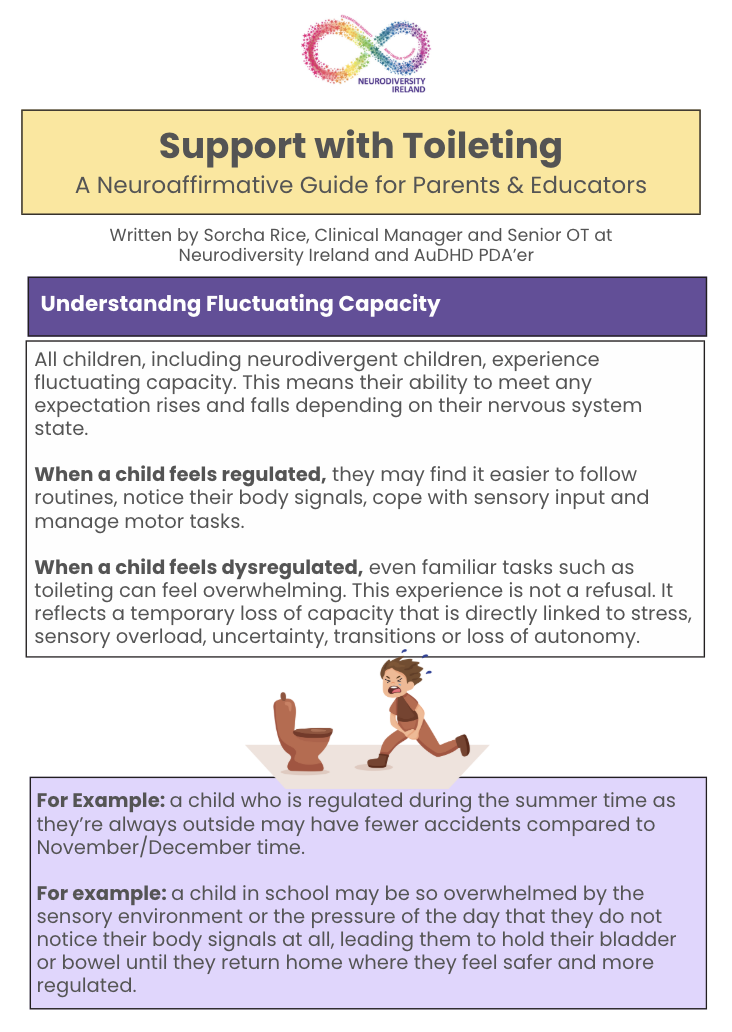
This neuroaffirmative handout supports parents and educators to understand toileting through a nervous system and capacity-based lens, rather than behaviour or compliance. It explains how fluctuating capacity, interoception differences, sensory processing, and regulation directly impact a child’s ability to toilet, and why difficulties are not refusal or laziness.
The resource offers practical, low-pressure strategies to support toileting through safety, predictability, sensory regulation, and autonomy, while clearly outlining why reward-based approaches can increase stress and disconnection. Grounded in evidence and lived experience, it helps adults respond with compassion and confidence when supporting neurodivergent children’s toileting needs.
-
Continence & PDA: Key Insights from Families brings together lived experiences from PDA’ers and their families to highlight the strong links between continence difficulties, nervous system regulation, interoception differences, and autonomy threat. Based on an anonymous survey shared with healthcare professionals, the document shows that toileting challenges such as constipation, withholding, accidents, and recurrent UTIs are widespread and often misunderstood.
Families consistently reported that pressure-based approaches — including rewards, timed toilet breaks, and rigid routines — increased distress, shutdown, and avoidance rather than helping. Difficulties were frequently masked in school settings, leading to delayed medical recognition and worsening health outcomes. Sensory-overwhelming or unpredictable bathrooms, loss of autonomy, and fear of pain were identified as key contributors to ongoing continence issues.
The findings emphasise that continence challenges in PDA are not behavioural, but rooted in nervous system overwhelm. What helps most is autonomy, predictable routines, safe and private sensory environments, early medical support, and an understanding of PDA as a nervous system–based disability. This resource centres lived experience to support more compassionate, effective, and neuroaffirmative continence care.
Toileting, Feeding, Self-Care etc.
-
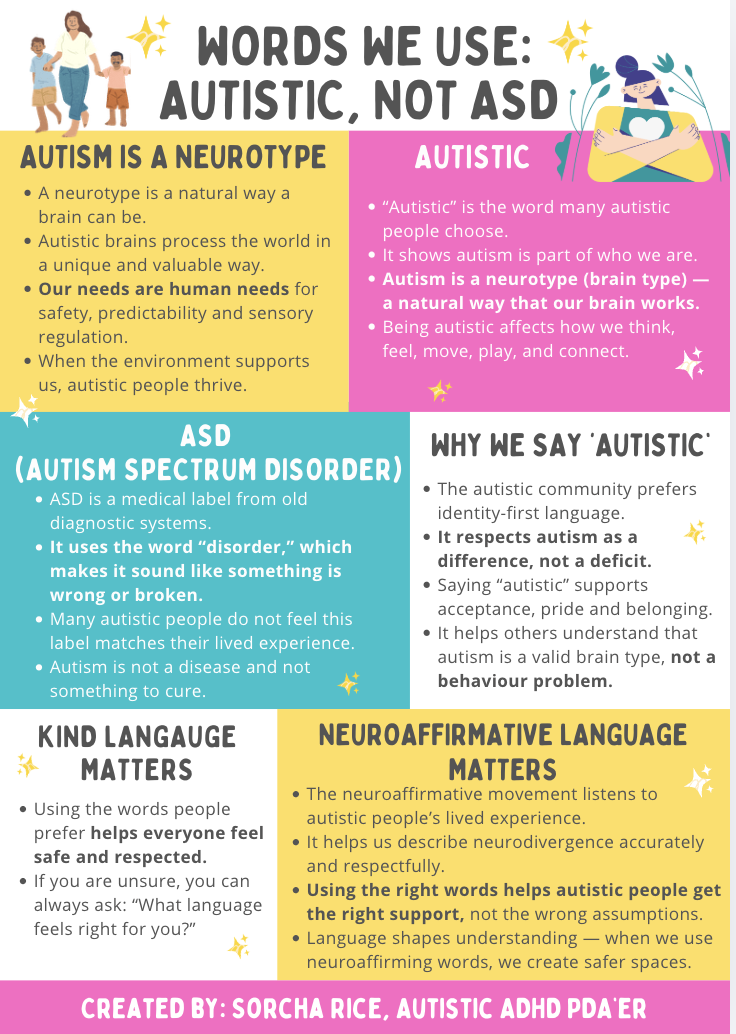
This resource explains why many autistic people prefer the term autistic rather than ASD, and why language matters for safety, dignity, and access to the right support.
It offers a simple, neuroaffirmative explanation of autism as a neurotype, not a disorder, and helps parents, educators, and professionals understand how words shape assumptions, expectations, and responses.
This is useful if you want to:
use language that autistic people actually prefer
move away from deficit-based or medicalised framing
create safer, more respectful environments
support understanding without pathologising
Designed to be clear, shareable, and accessible for schools, families, and professional settings.
-
This resource explains why the language we use in schools matters, and how terms like “autism unit” can unintentionally create separation, stigma, and low expectations.
It offers a clear, neuroaffirmative rationale for using “autism class” instead — framing these spaces as learning environments focused on belonging, safety, and support, rather than containment.
This is useful if you want to:
reflect on school language and its impact on autistic students
support dignity, belonging, and inclusion
align school practice with neuroaffirmative values
share a simple explanation with staff or families
Designed to be accessible, printable, and easy to share in school settings.